Status Check
NSFAS Status Meanings – What Each Status Code Tells You
Seeing an unfamiliar status on your myNSFAS portal can be stressful, especially when funding affects registration and accommodation. Most statuses are simply progress updates: they show where your application sits, whether NSFAS is still checking something, whether your institution still needs to act, or whether a decision has been made.
This guide explains the most common statuses in plain language, what each one usually means, and what you should do next. Wording on the portal can vary slightly between cycles, so always read the full message shown on your own profile alongside the status label.
How to Check Your Status Correctly
Start from the official NSFAS website and sign in to your myNSFAS profile using your identity number and password. Once signed in, look for the section that tracks your funding progress. That section should show your current status and, in many cases, a short explanation or a request for further information.
Your own portal message is the one that counts, not a screenshot shared by another student.
The Application Journey in Brief
An NSFAS application normally moves through several broad stages. First, NSFAS receives your application. Then it checks basic eligibility, verifies your personal details and household information, and assesses financial and academic eligibility. After that, it may wait for your institution to confirm admission or registration. Only then can a final funding outcome be confirmed and, where applicable, payments arranged.
Early Stages: Received, Filtering, and Verification
Early statuses show that NSFAS has your application and is working through its checks. Application Submitted means your application has been received and is waiting in the queue for processing. No action is usually needed, but check that your contact details are correct.
Middle Stages: Financial and Academic Assessment
Once basic checks are complete, NSFAS assesses whether you meet the financial and academic criteria. Statuses in this group may refer to funding eligibility, financial assessment, academic assessment, or awaiting academic results or admission.
Funding Eligibility generally means NSFAS is deciding whether you qualify financially. Awaiting Academic Results or Awaiting Admission means NSFAS is waiting for results or for confirmation that you have been admitted to an institution. In that case, make sure you have applied to your institution, accepted an offer where required, and submitted any results that NSFAS or the institution has asked for.
Provisionally Funded: Good News, but Not Yet Final
Provisionally Funded, sometimes described as funded subject to registration and availability of funds, is one of the most misunderstood statuses. It means you have passed the initial evaluations and met the funding criteria, but final confirmation still depends on further steps, most importantly your institution confirming your registration.
Think of it as a strong positive sign, not a final guarantee. You should register at your institution as required, complete any agreement that NSFAS asks you to sign, and keep checking your portal for updates. Do not assume that allowances will be paid before registration is confirmed, and do not make financial commitments that depend on funding before that confirmation is in place.
Approved, Funded, and Registration Received
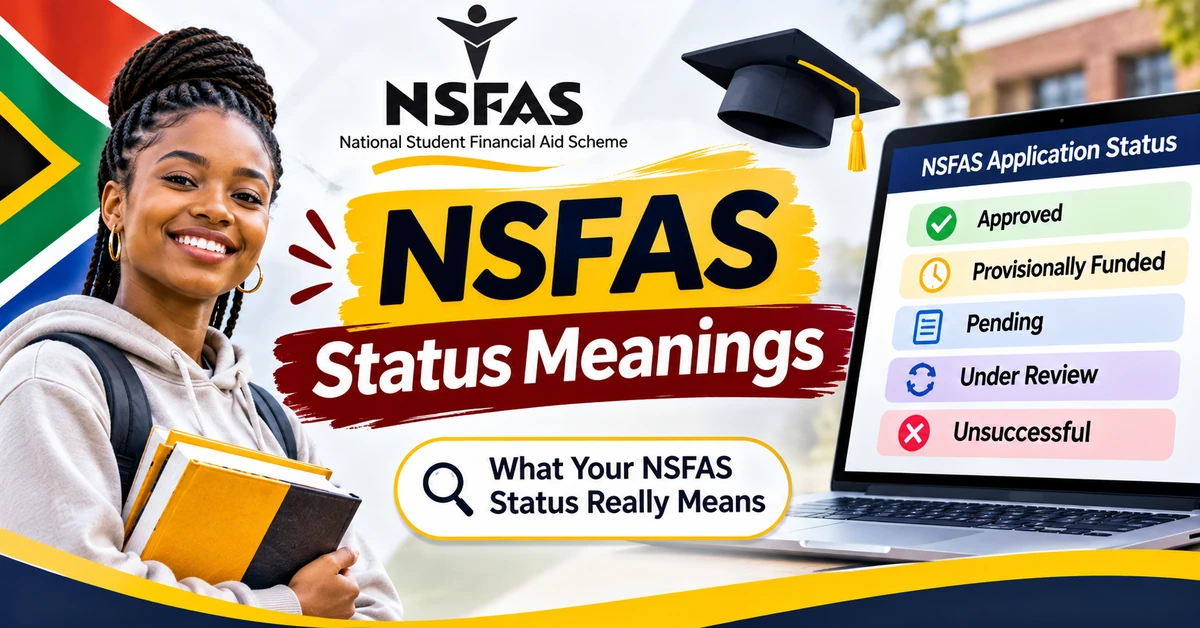
Approved, Funded, or Approved for Funding generally means your funding has been confirmed for the academic year. Registration Received means your institution has confirmed your registration to NSFAS. These are the statuses most students hope to see, but they still come with responsibilities.
You may need to sign a bursary agreement or, for loan funding, a loan agreement. Read the agreement before you sign it, keep a copy, and make sure your banking details, where required, are correct on the portal. If your institution, qualification, or registration details change after approval, tell your financial aid office promptly, because a change can affect funding.
Rejected, Unsuccessful, Declined, and Cancelled
Rejected, Unsuccessful, or Declined means your application did not meet the funding criteria or conditions for that cycle. The label alone does not tell you why, so read the reason shown on your portal. Common reasons include income assessed as above the threshold for the funding type, incomplete or unverified documents, a qualification that is not funded, or academic eligibility not being met.
An appeal may be possible, but only in certain circumstances and only within the appeal window shown on your portal. An appeal must address the actual reason for rejection with evidence. Students studying a qualification that NSFAS does not fund, and students who have exhausted the allowed funded period, are generally not able to appeal successfully on those grounds alone.
Statuses at a Glance
| Status | What it usually means | What you should do |
|---|---|---|
| Application Submitted | NSFAS has received your application | Wait, and keep your contact details up to date |
| Filtering / Under Review | Basic eligibility checks are under way | Wait, and respond promptly to any request |
| Validation | Personal details are being checked against other records | Make sure your details are correct |
| Evaluation | Supporting documents are being reviewed | Upload clearer documents if asked |
| Awaiting Documents | NSFAS needs a document from you | Upload the exact document requested as soon as possible |
| Funding Eligibility / Financial Assessment | Financial eligibility is being assessed | Wait, and keep proof of household income ready |
| Awaiting Academic Results / Admission | Results or admission confirmation are still needed | Confirm admission and submit results where required |
| Awaiting Registration | Your institution must confirm your registration | Register and follow up with your institution |
| Provisionally Funded | You meet the initial criteria, subject to registration and fund availability | Register, sign any required agreement, and keep checking your portal |
| Approved / Funded | Funding is confirmed for the academic year | Sign your agreement, check banking details, and follow payment updates |
| Rejected / Unsuccessful / Declined | Your application did not meet the criteria | Read the reason, then consider an appeal with evidence if eligible |
| Cancelled | The application was withdrawn or closed | Check why, and seek advice before reapplying in a future cycle |
When a Status Does Not Change for a Long Time
A status that stays the same for weeks does not always mean something is wrong. Applications are processed in large volumes, verification can depend on other organisations, and institutions send registration data in batches. However, a long pause combined with a request for documents, a mismatch in your details, or an institution that has not yet confirmed your registration is worth investigating.
Frequently Asked Questions
What does Provisionally Funded mean?
It means you have met the initial funding criteria, but final funding still depends on steps such as your institution confirming your registration. It is positive news, but it is not yet a final guarantee.
How long will my status stay Under Review?
Processing times vary by cycle and by how many applications are being handled. Verification and institutional confirmation can both add time. If no document is requested, waiting is often the correct step, but check your portal regularly.
What should I do if my status says Awaiting Documents?
Upload the exact document requested, in a clear and legible format, as soon as possible. Keep a copy for yourself and check later that the status has changed.
Does Approved mean my allowances will be paid immediately?
Not necessarily. Approval confirms funding, but payments depend on registration confirmation, institutional processes, and allowance schedules. Check your portal and your financial aid office if a payment is delayed.
Can I appeal a Rejected status?
An appeal may be possible if you can address the reason for rejection with evidence, and only within the appeal window shown on your portal. Read the reason carefully before you appeal.
Why does my friend have a different status when we applied together?
Applications are assessed individually. Differences in documents, household information, academic records, institution data, or registration timing can lead to different statuses, even for students who applied on the same day.
Conclusion
Your NSFAS status is a progress report, not a final verdict, until it reaches an approved or rejected outcome. Read the full message on your own portal, act quickly when a document is requested, register promptly when your institution requires it, and do not panic over a waiting stage that simply means checks are still under way. If your outcome is negative, read the reason first, then decide whether an appeal with proper evidence is the right next step. For the most reliable update, always start with your myNSFAS profile and your institution's financial aid office.