Eligibility & Requirements
NSFAS for TVET Colleges – Funding, Courses and How to Apply
If you plan to study at a Technical and Vocational Education and Training (TVET) college, NSFAS may help with your study costs — but only if you study at a public TVET college, on an approved programme, and meet the current eligibility criteria. This guide explains how TVET funding works, which courses are generally funded, what it may cover, and how to apply.
Programme availability, eligibility criteria and application windows can change, so always confirm the details for your own course and college on the official NSFAS website and with your college.
What Is a TVET College?
A TVET college is a public post-school institution offering vocational and occupational education: practical, career-focused training that prepares you for work, a trade or further study. South Africa has 50 public TVET colleges, many with several campuses, offering courses from short practical training to formal diploma programmes.
TVET study suits learners who want hands-on skills as well as theory. Colleges work closely with employers, so the skills you learn are meant to be usable in the workplace, not only in an examination room.
Public Colleges, Private Colleges and Approved Programmes
NSFAS funding for TVET study is for students at public TVET colleges. Private colleges are not funded through NSFAS in the same way, so confirm your college is public before you apply or register. Your college’s bursary office can confirm this, and the Department of Higher Education and Training (DHET) publishes information about public colleges.
Funding is also programme-specific. NSFAS funds ministerially approved programmes, so check with each college whether a particular programme is funded. Not every course on a prospectus will necessarily qualify, and checking before you enrol can prevent a costly surprise later.
The Main TVET Programme Types
Two formal programme families dominate TVET funding. The National Certificate (Vocational), known as NC(V), runs from Level 2 to Level 4 and combines theory with practical work. It is generally open to learners who have completed Grade 9 or higher, depending on the level, and completing Level 4 gives a qualification at the same level as Matric.
The second family is Report 191, often called NATED, which runs from N1 to N6. These programmes are generally post-Matric, with streams in engineering and in business and utility studies. After N6, a learner can work towards a National Diploma through relevant workplace experience. Some colleges also offer a Pre-Learning Programme for learners who need preparation before a formal programme.
| Programme | Typical entry point | What it leads to |
|---|---|---|
| NC(V) Levels 2 to 4 | Grade 9 or higher, depending on level | A vocational certificate, with Level 4 at Matric level |
| Report 191 (NATED) N1 to N6 | Generally Matric, depending on stream | N6, then workplace experience towards a National Diploma |
| Pre-Learning Programme | As advised by the college | Preparation for entry into a formal TVET programme |
Which Courses Are Generally Funded?
NSFAS states that it funds ministerially approved programmes, and the generally funded areas include engineering studies and business and utility studies. Engineering examples include engineering and related design, electrical infrastructure, civil engineering and construction, and information technology and computer science. Business examples include management, marketing, finance, office administration, hospitality, tourism, safety in society, and transport and logistics.
That list is a guide, not a promise that every similarly named course at every campus is funded. Availability varies by college and campus, and funding status can change. Always check the current prospectus for your chosen campus and confirm with the bursary office whether your exact programme qualifies.
Who Can Qualify for TVET Funding?
In broad terms, NSFAS TVET funding is for South African citizens who are registered, or intend to register, on an approved programme at a public TVET college and who are in need of financial assistance. NSFAS assesses financial need against its current criteria. This guide deliberately does not state a household income threshold or an allowance amount, because those figures can change and must be checked on the official NSFAS website for the current cycle.
Academic admission is separate from funding. Meeting NSFAS financial criteria does not guarantee a college place, and being admitted does not guarantee NSFAS funding. You need both. Learners with disabilities and learners receiving certain social grants may have additional considerations, so check the current official guidance for your situation.
What May NSFAS Funding Cover?
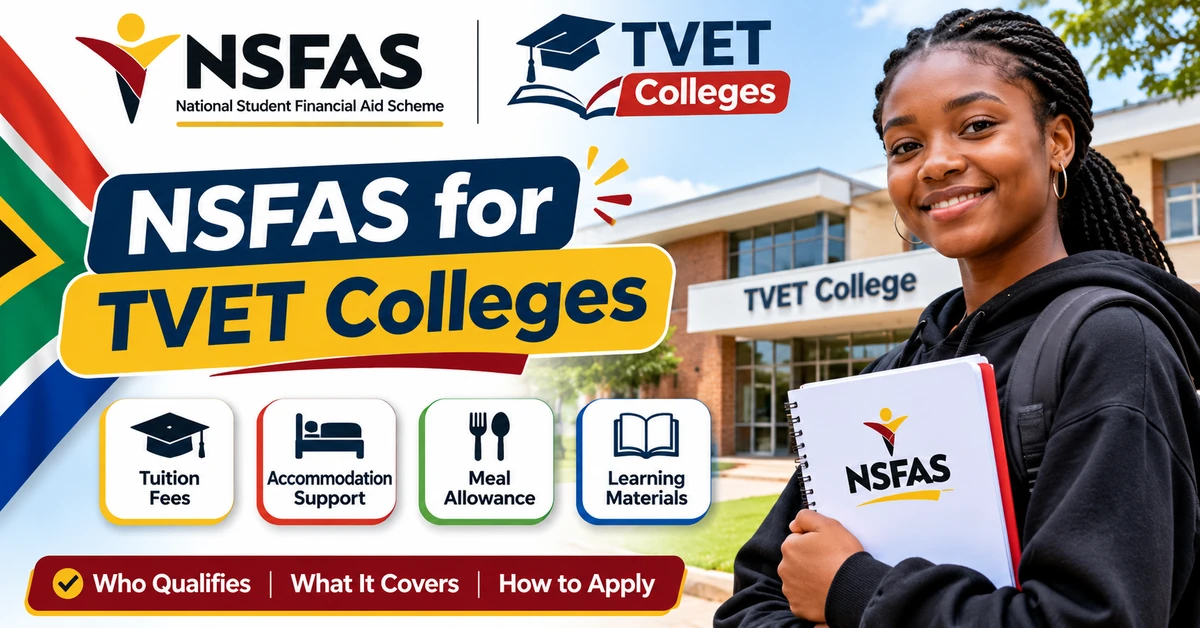
For qualifying TVET students, NSFAS funding is generally intended to cover study-related costs rather than to provide a general income. Tuition and registration costs for an approved programme are central, and allowances may also be provided for costs such as accommodation, transport and learning materials, depending on your circumstances and the current funding rules.
This guide does not list allowance amounts, because amounts and categories can change and can depend on factors such as whether you live at home or in college accommodation. Do not budget on an amount quoted in an older article or social media post. Confirm what your funding covers through myNSFAS and your college’s bursary office once funding is approved.
How to Apply: Two Applications, Not One
Applying for TVET funding involves two separate applications, and both matter. First, apply for admission to your chosen public TVET college and programme, following that college’s own process. Second, apply for NSFAS funding through myNSFAS, reached from the official NSFAS website. A college application alone does not give you NSFAS funding, and an NSFAS application alone does not give you a college place.
Start both early, and keep their reference numbers separate. You will need your identity document, your school results or certificates, and the supporting documents NSFAS asks for in myNSFAS, including the signed consent form. College bursary offices can help if you lack reliable internet access or are unsure about a step. Applying is free, so do not pay anyone to apply on your behalf.
After You Apply: Tracking, Registration and Support
After you submit both applications, track them separately. Use myNSFAS to follow your NSFAS status and respond promptly to document requests, and follow your college’s communication about admission, registration and orientation. A funding decision and an admission offer do not always arrive at the same time, so keep checking both.
Once admitted and funded, register as instructed by your college and attend any bursary briefing it offers. If you change programme, campus or accommodation, tell both NSFAS and your college promptly, because those changes can affect funding. Your college bursary office is often the fastest source of practical help.
Frequently Asked Questions
Does NSFAS fund private TVET colleges?
No, in general NSFAS TVET funding is for public TVET colleges on approved programmes. Confirm that your college is public before you rely on NSFAS funding.
Can I study at a TVET college without Matric?
It depends on the programme. NC(V) programmes are generally open to learners who have completed Grade 9 or higher, depending on the level, while Report 191 programmes are generally post-Matric. Check the entry requirements for your chosen programme.
Do I need to apply to the college as well as to NSFAS?
Yes. College admission and NSFAS funding are two separate applications. You need a place on an approved programme and a successful funding decision.
What is the difference between NC(V) and NATED?
NC(V) runs from Level 2 to Level 4 and combines theory with practical work. NATED, or Report 191, runs from N1 to N6 and is generally post-Matric, with workplace experience after N6 leading towards a National Diploma.
Does NSFAS cover accommodation and transport?
Funding may include allowances for costs such as accommodation, transport and learning materials, depending on your circumstances and the current funding rules. Amounts are not stated here and must be confirmed officially.
What if my course is not on the funded list?
Check with your college’s bursary office and on the official NSFAS website whether your exact programme at your exact campus is approved and funded. Do not assume a similar course name means the same funding status.
Where can I get help with my application?
Your chosen college’s bursary office can help with both admission and NSFAS questions, and NSFAS publishes official guidance and support channels on its website. This guide does not list a contact number here, because those details must be checked on the official site.
Conclusion
NSFAS can open the door to TVET study, but the key steps are in your hands: choose a public TVET college, confirm your exact programme is approved and funded, apply both to the college and to NSFAS, and submit clear documents on time. Tracking both applications prevents the most common disappointment: securing one without the other.
As a next step, shortlist one or two public TVET colleges, check their prospectuses for a programme matching your results and interests, and confirm current eligibility criteria and the application window with the bursary office or official NSFAS website before you apply.