Eligibility & Requirements
NSFAS and SASSA – How They Work Together for Students
Introduction
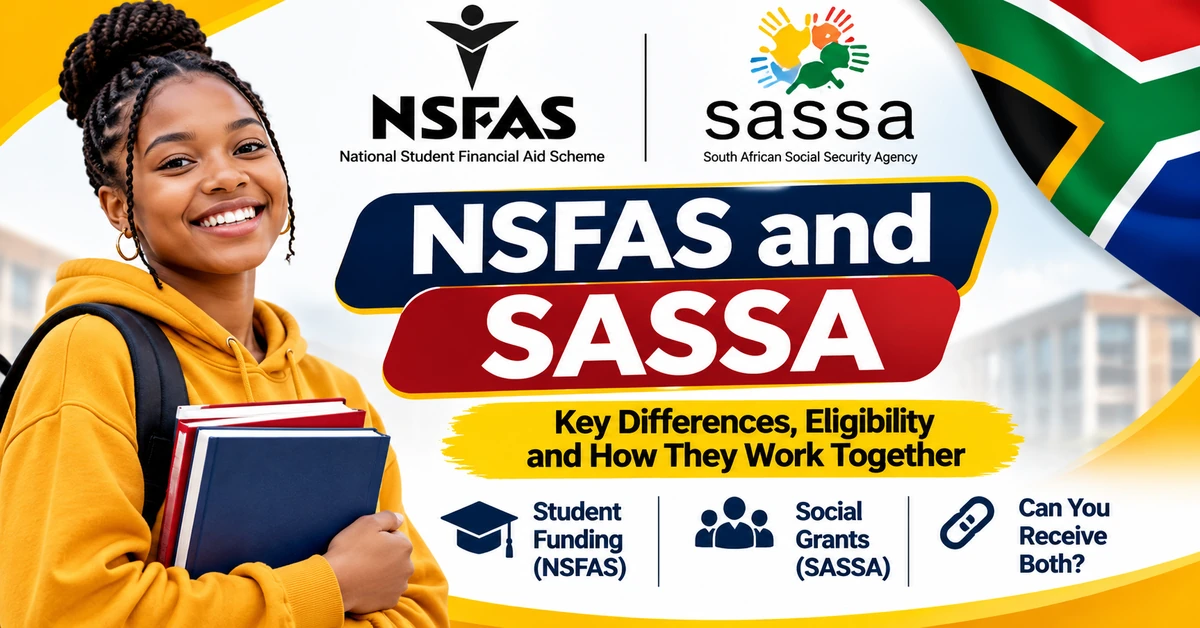
NSFAS and SASSA are two different South African government systems, but for many students they work closely together. SASSA, the South African Social Security Agency, administers social grants to households and individuals who qualify. NSFAS, the National Student Financial Aid Scheme, funds eligible students at public universities and TVET colleges. The link between them is financial eligibility: NSFAS guidance describes verified SASSA grant recipients as automatically meeting the financial requirement for NSFAS funding. That link is helpful, but widely misunderstood. A SASSA grant does not, on its own, register you for NSFAS, admit you to an institution, or guarantee funding.
Two Systems, Two Different Jobs
SASSA's job is social support: it assesses and pays grants that help households meet basic needs. NSFAS's job is student funding at public institutions. Because both serve households under financial pressure, they share information in a controlled way. When you apply to NSFAS, you consent to verification with third parties, which can include SASSA, so it can often confirm a grant without asking the family to prove income again. Each system still makes its own decision, under its own rules.
How a SASSA Grant Helps an NSFAS Application
For most NSFAS applicants, financial eligibility depends on household income. Families are normally asked to show what the household earns, so NSFAS can judge whether it falls within the limit that applies to that applicant's category. That process can be stressful for households with informal or seasonal income, or no payslips. NSFAS guidance states that verified SASSA grant recipients automatically meet the financial requirement. In practice, if NSFAS can verify through SASSA's records that you are a recipient, the income test is treated as met. Note the word verified: the grant must be verifiable in the records NSFAS checks, and your details must match those records, or NSFAS may ask for further information.
Which Grants Count? Check, Do Not Assume
Students often ask which SASSA grants count, and whether every grant counts in the same way. Be especially careful here, because summaries from different sources do not always agree, and the rules can change. Some guidance refers specifically to grants such as the Child Support Grant, the Foster Child Grant, and the Care Dependency Grant, including cases where a person received such a grant within a recent period before applying. Other guidance raises a specific question about the Social Relief of Distress grant, and whether it is treated in the same way. Because this article has not verified the current grant-by-grant list directly from a current official NSFAS source in this writing pass, this guide does not present a definitive list as fact. If you receive a SASSA grant, say so accurately, give the required consent for verification, and check the current official NSFAS criteria for your category.
What a SASSA Grant Does Not Do
| What the grant link does | What it does not do |
|---|---|
| May meet the NSFAS financial requirement, if verified | Register you, admit you, or guarantee funding |
| May remove separate proof of income for that check | Replace other documents, academic checks, or registration |
Even where a grant meets the financial requirement, it does not complete the rest of your application. You must still apply through myNSFAS, provide the required documents, and meet the academic and institutional requirements. You must be admitted to or registered for an approved qualification at a public university or TVET college. Funding is not available for private institutions through NSFAS, and it is not available simply because a household receives a grant. A grant also does not guarantee approval: NSFAS checks academic eligibility, programme eligibility, previous funding history, and other factors, and funding depends on confirmation of your registration. Receiving a SASSA grant does not mean other household members lose their grants because you receive NSFAS funding; grants and funding are assessed person by person.
Applying as a SASSA Household: Practical Steps
Apply on myNSFAS in the normal way, and complete every section honestly. Make sure your identity number, name, and contact details are correct, because verification depends on matching records, and sign the consent form allowing NSFAS to verify your details, including with SASSA; without it, your application may be delayed or closed. Keep the documents NSFAS asks for ready, even if you expect the financial check to be automatic, including identity documents, proof of admission or registration, and academic records, and upload any additional document promptly.
SASSA Grants and Other Family Members
A household often contains several grant recipients, and each person's grant or funding is assessed on its own merits. A student's NSFAS application does not, by itself, cancel a caregiver's grant, and a caregiver's grant does not, by itself, fund the student. One area needs current official guidance: whether a student funded by NSFAS can, at the same time, personally receive a particular short-term relief grant for the same period. Sources describe this differently, so this guide states no definitive rule; check with SASSA and NSFAS through official channels if it applies to you.
If Your Application Is Unsuccessful Despite a Grant
If you are a SASSA grant recipient and your NSFAS application is unsuccessful, read the reason given on myNSFAS before concluding that the grant was the problem. Common reasons include missing documents, an unsigned consent form, a mismatch in personal details, an academic requirement not met, or a programme or institution that is not covered. If the reason relates to financial eligibility and you believe your grant should have been verified, gather any official proof you hold and consider the appeal process shown on myNSFAS. Appeals have their own requirements and time limits, so act promptly and follow the instructions on your account. Your institution's financial aid office can often help you understand the reason and prepare an appeal.
Avoiding Scams That Use the SASSA Link
The SASSA and NSFAS link is sometimes used by scammers. Be wary of anyone who charges a fee to link your grant to NSFAS, promises guaranteed funding because you receive a grant, or asks for your password, banking details, or identity document through a messaging app. Neither NSFAS nor SASSA charges a fee for an application, and neither will ask for your password. Use only the official NSFAS website and myNSFAS portal, and the official SASSA channels published by SASSA. If you receive a message claiming your funding or grant has been approved and asking you to click a link or pay a fee, do not act on it until you have checked your own official account.
Frequently Asked Questions
Does receiving a SASSA grant mean I automatically get NSFAS funding?
No. NSFAS guidance describes verified SASSA grant recipients as automatically meeting the financial requirement, but you must still apply, meet the academic and institutional requirements, and have your registration confirmed.
Do I still need to provide proof of income if I receive a SASSA grant?
In many cases, NSFAS verifies the grant directly with SASSA, so separate proof of income may not be required for the financial check. You may still need other documents, such as identity documents and proof of admission or registration.
Does every SASSA grant count in the same way for NSFAS?
Do not assume so. Different sources describe different grant types differently, and the rules can change. Check the current official NSFAS criteria for your applicant category.
Will my family's SASSA grants stop if I get NSFAS funding?
In general, grants held by other family members are assessed separately and are not cancelled simply because you receive student funding. If you are told otherwise, verify the claim with SASSA and NSFAS through official channels.
Can I receive a SASSA grant and NSFAS funding at the same time?
This depends on the specific grant, the person receiving it, and the funding period. Check current official guidance from SASSA and NSFAS for your situation rather than relying on a general summary.
What should I do if my grant is not verified on my NSFAS application?
Check that your personal details match your official documents, make sure your consent form is signed, and respond to any document request on myNSFAS. If the problem continues, contact NSFAS through an official channel or ask your institution's financial aid office for help.
Conclusion
The NSFAS and SASSA link is genuinely helpful: for verified grant recipients, it can remove the need to prove household income separately. But it is only one part of a successful application. Apply properly, give consent for verification, meet the academic and institutional requirements, register, and track your application on myNSFAS. If anything about your grant type is unclear, check the current official NSFAS criteria first.